When I started building Pokemon Aura RPG, I was not trying to make a short arcade loop. I wanted a long-form browser experience that players could keep open in a tab while doing other things, the way people listen to playlists or podcasts.
That meant treating the game less like a traditional session based title and more like a steady background activity. In practice, that design goal affected almost every decision, from the core loop to UI pacing to how the economy works in a pokemon rpg that expects to live beside other apps, not in front of them.
Below is how I approached it from a game design and web dev point of view.
1. Defining “Background Play”
“Background play” sounds simple, but it helps to define what it actually means in design terms. For me it meant:
- The player can make meaningful progress in 5 to 15 minutes
- The game never punishes tabbing out or leaving mid action
- The core loop consists of repeatable, low friction actions
- The UI stays readable even when returning after hours away
This ruled out a lot of mechanics that rely on high APM or real time reactions. Instead, I leaned into turn based combat, route based exploration, and menu driven management. All of those work well when the game is running beside a stream, voice chat, or other browser tabs.
2. Building a Slow but Satisfying Core Loop
The basic loop looks familiar to anyone who has played a monster collecting RPG:
- Pick a route or activity
- Trigger encounters and battles
- Earn experience, items, and currency
- Improve your team and repeat
The challenge was to pace it so that:
- A single route does not drag on for so long that a player feels locked in
- Rewards are visible after a small number of actions
- There is always a clear “next small step” available
In practice, that meant:
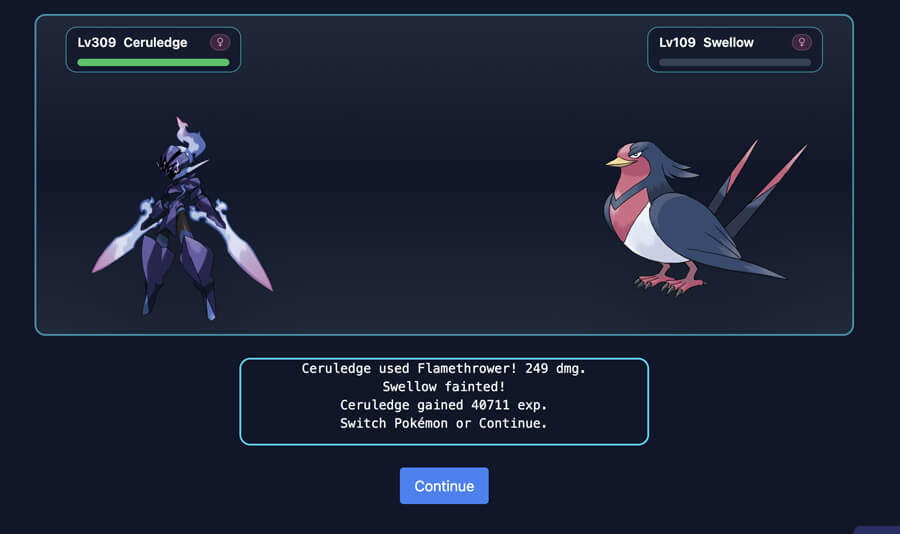
- Keeping encounter animations short and skippable
- Making early routes quick, then layering complexity later
- Giving out small, guaranteed rewards in addition to rare drops
A player who only has time for two or three battles should still feel like they moved some needle, not like they barely got started.
3. Designing for Tab Hopping and Interruptions
Browser users tab hop constantly, so I treated that as a feature instead of a problem.
Some concrete choices:
- Turn based only
No real time timers that continue during a fight. If you leave mid battle, nothing breaks, and you are not punished when you come back. - Clear state indicators
The UI always shows what you were doing last. If you return after an hour, it should be obvious whether you were on a route, in a menu, or in the middle of a quest. - No “session only” rewards
Progress is saved frequently. You are not required to finish a dungeon or series of fights in one sitting to keep your rewards.
Technical side, this pushed me toward simple, stateless API calls and very explicit server side tracking of player state. The server never assumes a continuous session, it only cares about the last valid action.
4. Session Length and Route Design
Routes are the main container for moment to moment play, so I tuned them around expected session lengths.
Some design rules I used:
- A “short session” route should be clearable in 3 to 5 minutes
- A “medium session” route in roughly 10 to 15 minutes
- Longer grinds are chained optional activities, not required content
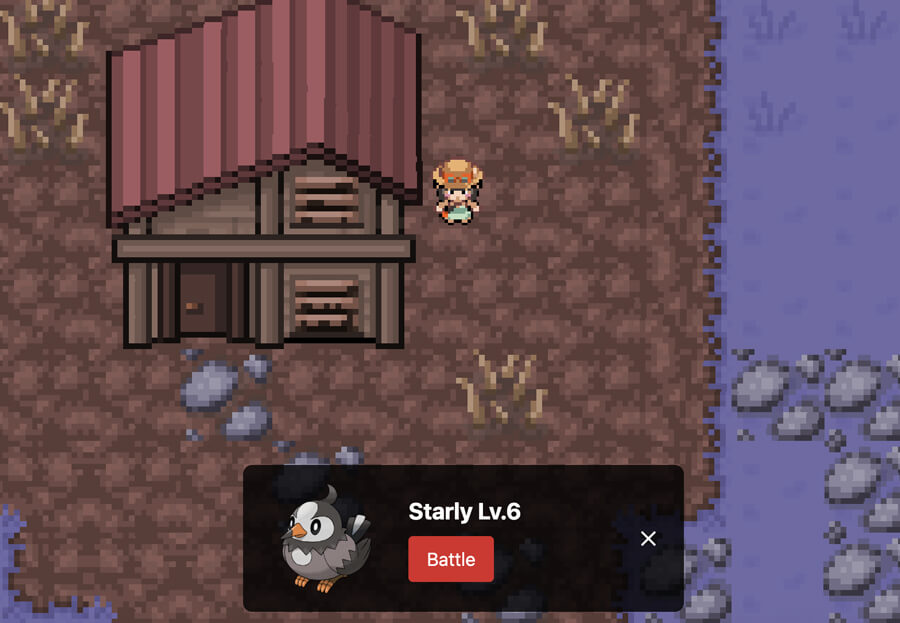
Instead of huge, maze like areas, I prefer smaller routes that can be repeated and combined. Players who want to binge can chain multiple runs, while players on a break can run a single route and log out satisfied.
5. Long Term Goals That Do Not Expire
Background games need strong long term goals or people drift away. At the same time, hard deadlines can feel hostile when players are busy.
To balance that, I built three layers of progression:
- Short term
Daily tasks, quick quests, single level ups. - Mid term
Completing a region, building a specific team, unlocking a feature. - Long term
Rare variants, collection milestones, prestige level targets.
Time limited events exist, but they are meant as bonuses, not requirements. Missing an event should never make someone feel like their account is permanently weaker. That is especially important for a online pokemon rpg that expects players to come and go around real life.
6. UI and UX for “Glanceable” Play
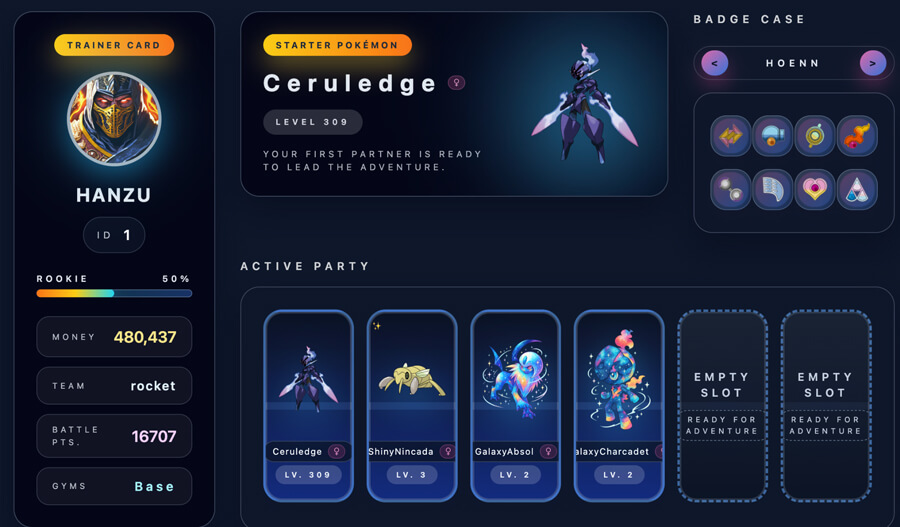
Because the game sits in a tab, the UI has to be glanceable. When you alt tab back, you should instantly understand:
- Your current party and their status
- Your current activity or route
- The most obvious next action
Some UX decisions:
- Keep important data on screen without deep menu drilling
- Use consistent layout patterns across pages
- Avoid cluttered screens with too many competing panels
From a front end perspective, this means careful component reuse and predictable state changes. Animations are subtle instead of flashy, so they do not become annoying when you are checking in repeatedly.
7. Performance Considerations in a Browser Context
A long form browser game has to be light enough to run alongside other apps without feeling heavy.
Key performance choices:
- Minimal client side libraries, keep bundles lean
- Cache static assets aggressively
- Use incremental rendering where possible instead of blocking calls
- Design backend endpoints that return only what the current screen needs
Players will abandon any “background game” that causes stutter in their main game or video. Performance is part of game feel even when the mechanics are turn based.
8. Embracing the Role of “Comfort Game”
The final mental shift was accepting that this kind of project is not meant to be a main event title all the time. It is fine if players treat it as:
- Something to open during queue times
- A comfort grind at the end of the night
- A familiar loop they return to between big releases
Designing around that role changes your priorities. Instead of chasing the flashiest moment, you optimise for reliability, clarity, and gentle progression. Sessions should end cleanly so that players are happy to come back tomorrow.
Designing a long form Pokémon style browser game for background play is as much about restraint as it is about features. By accepting the realities of how people use their browsers and how fragmented modern gaming time is, you can create something that quietly fits into their daily routine, one short session at a time.
🔙 Back to Articles list.