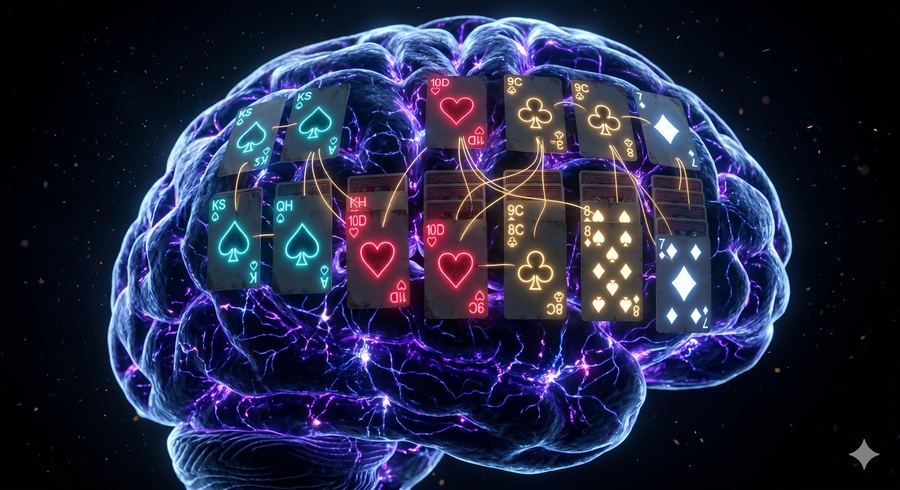
Most articles on solitaire and brain health are wrong - not because they lie, but because they treat all solitaire as equivalent. The cognitive gap between Klondike and 4-Suit Spider isn't a matter of difficulty. It's a matter of which neural circuits you're actually recruiting.
The Problem With "Solitaire Is Good for Your Brain"
Search for "solitaire brain benefits" and you'll find dozens of articles that read like they were generated in parallel: improves memory, reduces stress, boosts concentration. None of them are lying, but nearly all describe the benefits of any low-stakes card game - or any moderately engaging activity that isn't passive screen consumption.
What they're missing is the neuroscience of specificity. Different cognitive tasks recruit different neural circuits, and not all circuits benefit equally from training. The question isn't "is solitaire good for your brain?" - it's "which variant activates the circuits that matter most for long-term cognitive health?"
The answer, when you look at the actual neuroscience, points clearly to Spider Solitaire - specifically the 4-suit variant. Here's why.
What Most Solitaire Games Actually Exercise (And Why It's Not Enough)
Klondike - what most people mean when they say "solitaire" - has a structural problem from a neuroscience standpoint: roughly 20–30% of deals are unwinnable regardless of play quality. More critically, once a player internalizes Klondike's rules and common patterns (around 20–50 hours of play), continued play offers diminishing cognitive returns. The game becomes automatized - shifted from the prefrontal cortex (deliberate, effortful processing) to the basal ganglia (habit-based, low-effort execution). The same transition that happens when you learn to drive: initially demanding, eventually automatic.
Automatization is neurologically efficient, but it is not cognitively protective. The brain stops adapting once a task becomes routine.
What Makes Spider Solitaire Neurologically Different
1. Hierarchical Constraint Satisfaction Under Uncertainty
Spider Solitaire at the 4-suit level requires simultaneously managing multiple goal hierarchies: building complete same-suit sequences, maintaining playable columns, optimizing stock draws, and tracking suit distributions across visible and concealed positions.
Cognitive neuroscientists call this hierarchical constraint satisfaction - satisfying multiple constraints at multiple levels of abstraction while the state space shifts with every move. fMRI studies of analogous tasks (multi-step planning in the Tower of London paradigm) show robust activation in the dorsolateral prefrontal cortex (dlPFC), the anterior cingulate cortex (ACC), and parietal association areas - the canonical executive function network.
Critically, 4-suit Spider keeps this network engaged because the game never fully automatizes. The combinatorial complexity of suit interactions means even expert players encounter genuinely novel configurations. Neuroplasticity requires novelty. Without it, practice is just rehearsal.
2. The Chunking Ceiling Is Dramatically Higher
One of the most replicated findings in expertise research is chunking: experts in complex domains perceive the environment in meaningful units rather than individual elements. A chess grandmaster doesn't see 32 pieces - they see four or five salient configurations.
Spider players develop chunking too - 8♠ 7♠ 6♠ 5♠ becomes a single perceived unit. But unlike Klondike, where meaningful chunks are simple and few, 4-suit Spider has a chunking ceiling orders of magnitude higher. The interaction between suit membership, sequence continuity, and column position creates a space where expert chunking requires genuinely sophisticated perceptual learning. Perceptual chunking is associated with structural changes in posterior cortical areas (inferior temporal cortex), while maintaining those chunks under load engages working memory circuits in the parietal-frontal network. Spider 4-suit consistently taxes both.
3. Dual-Process Interleaving - The Workout Most Games Skip
Kahneman's dual-process framework is well-known, but what's underappreciated is that switching between System 1 and System 2 is itself cognitively demanding. It requires the ACC to detect when a habitual response is insufficient and recruit the prefrontal cortex for deliberate override.
Spider forces this switching continuously:
- System 1 engages when you recognize a legal move pattern automatically
- System 2 engages when that move threatens a future constraint violation
- The switch itself activates the ACC's conflict-monitoring function
This cycling - recognize, evaluate, override or execute, re-scan - mirrors dual-task cognitive training paradigms that have shown transfer effects to real-world executive function. Most solitaire games operate primarily in System 1 once learned. Spider 4-suit keeps the switching active throughout.
The Cognitive Reserve Argument
Neuroscientist Yaakov Stern's cognitive reserve hypothesis proposes that mentally demanding leisure activity builds a reserve that delays the symptomatic onset of neurodegenerative disease, even as underlying pathology progresses. The critical word is demanding. Activities that become automatized do not confer the same benefit - you're spending time but not building reserve.
The ideal cognitive leisure activity is one that remains effortful across extended engagement. Spider Solitaire 4-suit satisfies this in a way simpler card games do not. The problem space is vast enough that mastery is asymptotic - always approachable, never fully achieved.
The Contrarian Point Solitaire Content Misses
Easy solitaire may be cognitively neutral or mildly negative for players who have already learned it, because it displaces time that could be spent on genuinely demanding activity while providing the psychological feeling of mental engagement. This is the cognitive equivalent of taking a walk and believing you've done strength training.
If the goal is brain health, the prescription isn't "play solitaire." It's "play the hardest variant you can engage with without quitting from frustration" - which for most experienced players means 4-suit Spider.
The neurological sweet spot is the edge of competence: challenging enough to require System 2 engagement, tractable enough to sustain continued play. Spider's difficulty gradient - 1-suit through 4-suit - is ideally structured to keep players in that zone as their skills develop.
Practical Implications
Advance to 4-suit as soon as 2-suit feels comfortable. The jump in complexity is where meaningful neural engagement begins. Staying at 2-suit beyond the learning phase is staying in the automatization zone.
Avoid undo-heavy play. Frequent undos reduce the cost of poor planning and lower executive function demand. Reflexive undo after every mistake undermines the cognitive workout.
Reflect between games. Mentally reviewing what went wrong - which column became a dead end, which stock draw forced a suboptimal state - activates the same prefrontal consolidation processes that make deliberate practice effective in any domain.
The Bottom Line
The more precise claim, supported by the neuroscience of executive function, working memory, chunking, and cognitive reserve, is this:
4-suit Spider Solitaire is one of the few casual, accessible activities that reliably recruits the prefrontal-parietal executive network, sustains dual-process switching, supports expert-level perceptual chunking, and resists full automatization - the specific combination associated with cognitive reserve building.
That's considerably stronger than "it helps with concentration." And unlike most brain-training content, it has a mechanistic basis.
References: Stern, Y. (2009). Cognitive reserve. Neuropsychologia. | Diamond, A. (2013). Executive functions. Annual Review of Psychology. | Kahneman, D. (2011). Thinking, Fast and Slow. | Chase & Simon (1973). Perception in chess. Cognitive Psychology.
🔙 Back to Articles list.