Why flat ground is worth money in Zero-G
Imagine buying a plot on the Moon and discovering that the view is the cheapest thing about it. In Zero-G, placing a base on a ridge means paying for the material that fills the space beneath the platform. Move the beacon onto a nearby plain and the estimate changes while you watch. A height map that once helped you pick out craters from orbit now has a say in whether you can afford the landing pad.
The November 2 Terra Firma update brought player-built bases to Zero-G’s browser MMO, where pilots share a persistent Solar System. The team’s press kit names Three.js and WebGL on the rendering side and Node.js in its stack. The Moon and Mars draw on elevation measurements from NASA missions. One particularly good reason to look at the game is how that real topography follows a player all the way from an orbital map to a construction bill.
When a map becomes a place
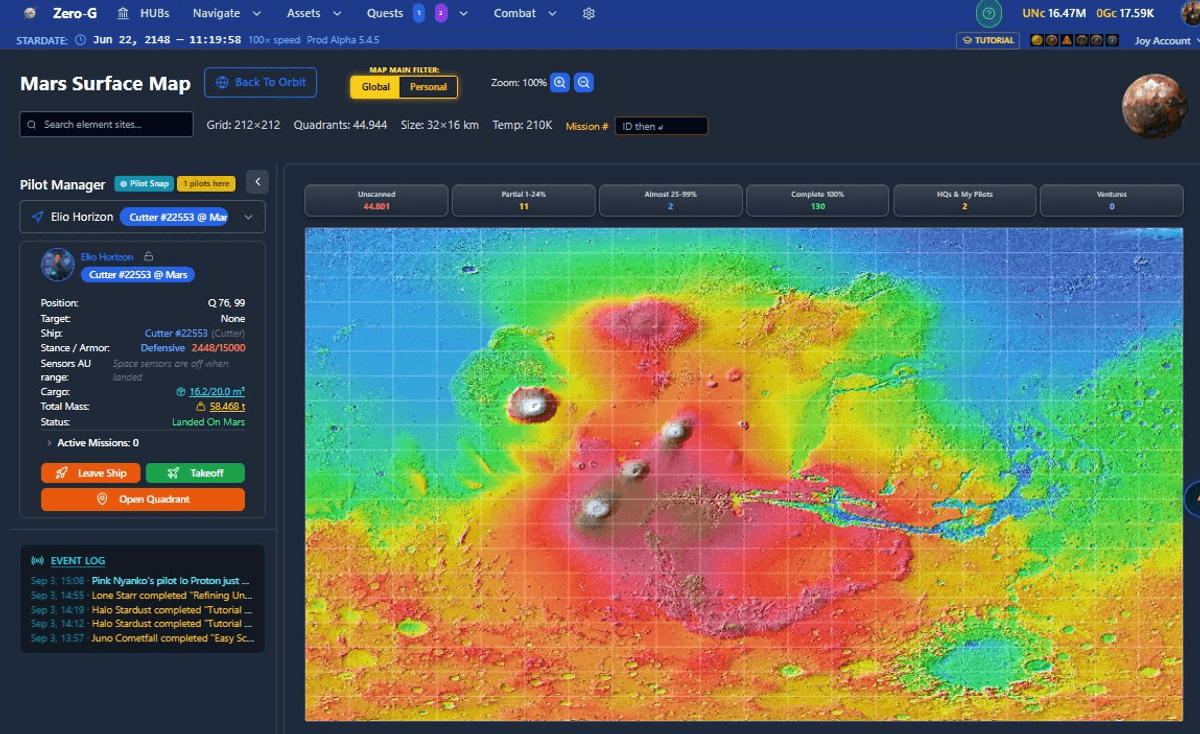
The Mars map is a good place to start. Olympus Mons and the long trough of Valles Marineris are recognisable because elevation changes survive the change of scale. On the Moon, the Lunar Orbiter Laser Altimeter measures the surface relief that gives a broad crater its shape. Measurements have a spatial resolution. Flying closer can reveal finer detail that a game synthesises between measurements, so a recognisable crater and an individual bump under a landing strut have different origins.
That distinction is useful if you build worlds for the web. Our Three.js paint trail uses a height map to change the light falling on a flat surface. A landing game asks a harder question of the same kind of data. If the player sees a ridge, can they land on it, and will the base builder agree about its height when they return? The rendering, landing and construction systems all need a consistent answer at that spot.
The price of levelling a platform
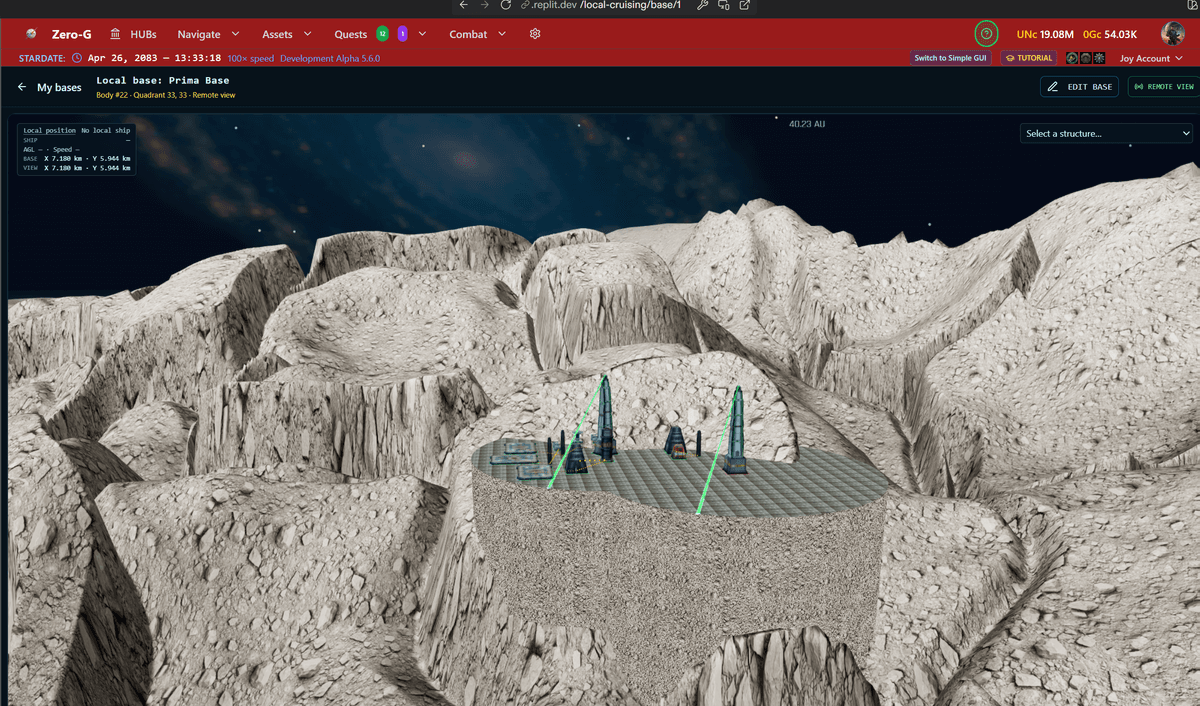
The developers’ guide to building a first base takes a pilot from purchasing a circular, 100-metre-wide claim to positioning a beacon called a Pharus. The player can move it inside the claim and inspect the cost before committing. Ground below the platform level needs fill. Ground that already stands higher can protrude through it. Two sites on the same plot can therefore carry very different price tags.
Consider a simple estimate of our own. If one quarter of a 100-metre-diameter platform has a gap averaging two metres beneath it, that part alone needs about 3,927 cubic metres of fill. The calculation is a quarter of the circle’s area multiplied by the gap. It’s an illustration of the geometry, and the game has its own pricing. The calculation gives a designer a reason to display a live estimate while the player is moving the beacon. A one-metre change across a wide area is hard to judge by eye.
How much terrain has to travel?
The team’s engineering notes put numbers on a different body, Mercury. They estimate that materialising one whole quadrant at its finest detail would take 7.7 terabytes, and report a 2.2 MiB footprint for the browser representation in their example. Those figures describe one terrain case. They’re a useful reminder to ask what a player needs at the current location and zoom level before putting a size on an entire planet.
There’s a small-scale cousin in Frank Force’s City in a Bottle, which generates a city view from a 256-byte HTML file. The js13kGames 2026 winners had a different budget again, measured in the ZIP players download. For your own terrain experiment, measure the transfer, the memory occupied by the current patch and the time to reconstruct it after a reload. Then go back to the same ridge. A small download is good news, but the player who paid for that foundation also wants to find it where they left it.

HTML5 Game Developer, Enclave Games indie studio founder, js13kGames competition creator and Gamedev.js Weekly newsletter publisher. Mozilla Tech Speaker, Gamedev.js community firestarter. Organizes meetups / workshops / hackathons in Poland, passionate about new, Open Web technologies, excited about WebXR and PWAs. Likes eating sushi and playing Neuroshima Hex.