
The first warning in HADAL comes from the hull. In a new development post about pressure, Zone Two Games explains why its research vehicle starts creaking before an alert appears on the display. It is a useful detail in a browser game where descending is easy and getting home needs some thought.
HADAL: Into the Mariana Trench is Tomáš Stankovič’s exploration game, built with Phaser 4 and TypeScript. The free browser demo follows the first dives off Guam; the larger expedition is planned for Steam in 2027. Nothing needs to chase the player to make the next stretch of dark water feel consequential.
A warning with time to act
The developer puts the demo vehicle’s rated depth at 1,200 metres. Hull sounds begin at roughly three quarters of the corresponding pressure, around 900 metres in the demo. Passing the rating introduces a chance of failure that grows with depth, rather than an immediate, guaranteed break. Wear can also reduce the safe depth until the vehicle is serviced.
That gives the sound a clear job. It signals a change in the situation while there is still a decision to make. A noise that arrives only after damage is useful confirmation, but it cannot help someone reconsider the action that caused it. Here the player has a reason to notice the vehicle itself while looking for something in the lamp beam.
Our Songs of Hyrule feature examined how several responses can make one interaction understandable. HADAL suggests a related design exercise: place a warning earlier in a sequence, then watch whether a new player changes course. For an accessible implementation in your own game, provide a visible equivalent as well; a muted phone should still communicate the risk.
The return trip belongs in the budget
According to the current browser demo description, the vehicle descends under steel ballast and rises after releasing it. Cold and lighting consume battery capacity, which must cover the ascent too. The absence of a countdown does not remove the cost of spending longer underwater.
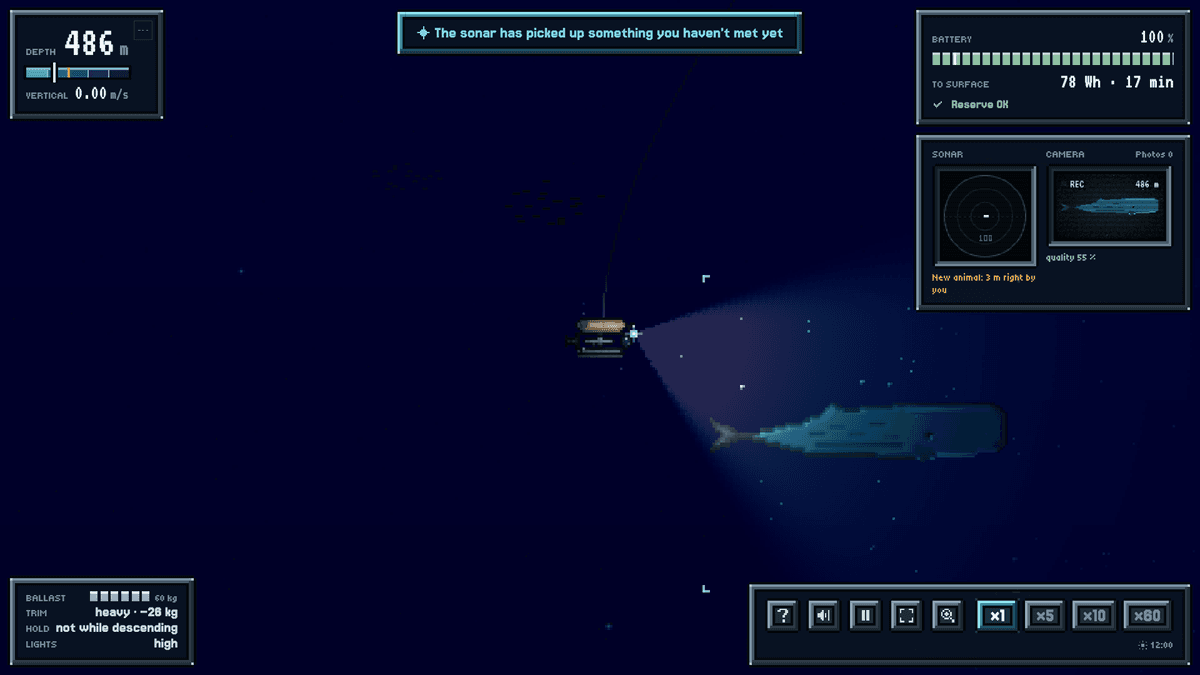
Consider the difference between showing “battery remaining” and helping someone judge “battery needed to return”. One describes a resource; the other connects that resource to an obligation. The supplied screenshot makes that distinction visible through its return estimate and reserve indicator. It gives a developer something more concrete to study than the usual instruction to make a resource bar clearer.
The terrain in our Zero-G article similarly turns an environmental property into a practical decision. A view, a ridge or a depth reading becomes more interesting when the player understands what choosing it will cost. The useful question is whether that cost becomes legible before commitment.
Build the atmosphere from the same rules
The developer’s technical notes shared with Phaser describe a light map combining the fading sunlight, vehicle lamp and surface caustics. Sprite normal maps are generated from the pixel art, and audio is synthesised live with Web Audio. These are implementation details with a direct connection to what the player needs to notice.
Daniel’s Slime & Steel development account offers another example of drawing game art through code. For a smaller audio experiment, our ZzFX Studio walkthrough shows a separate approach to delivering generated sound in a browser game. Neither is a requirement for using a well-timed warning: a carefully placed recording could serve that design purpose too.
Let discoveries lead somewhere
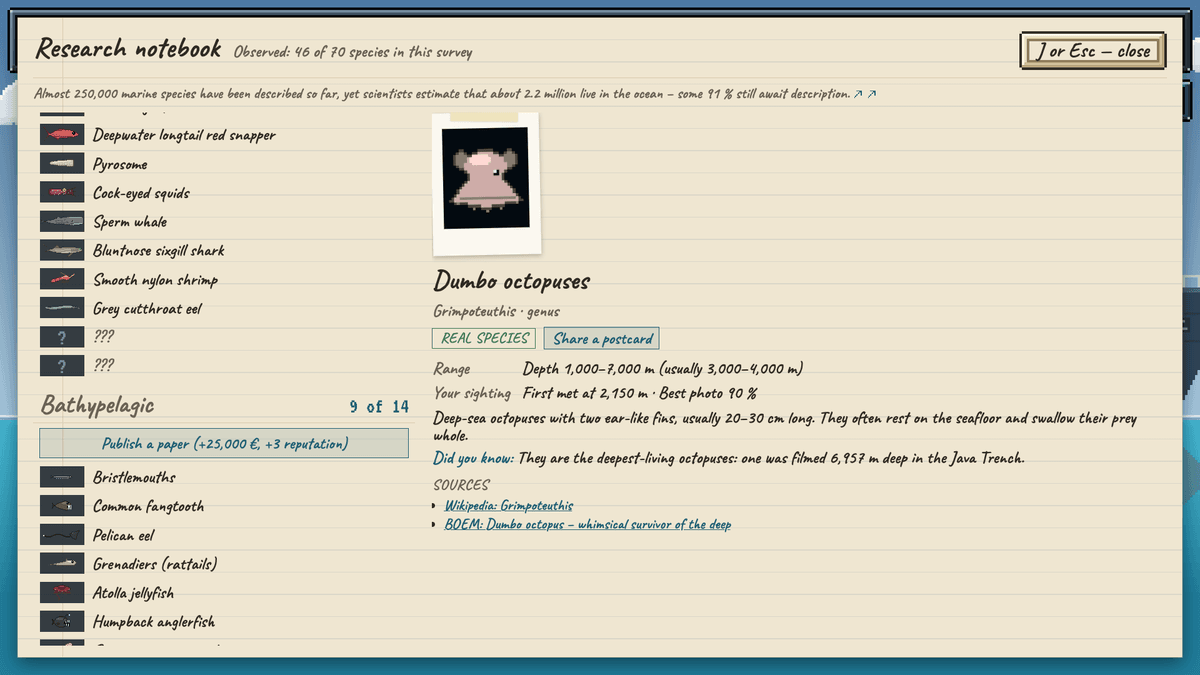
The HADAL press kit describes a research journal that gives real species their scientific sources and labels invented creatures separately. The notebook screenshot shows how a sighting becomes a record someone can inspect, rather than a notification that vanishes. The developer also discloses AI assistance with code and writing, while describing the art and audio as generated by the game’s own code.
Open the free browser demo with sound available and pay attention to the moment exploration starts to feel like a return journey. That change of mind is the part worth studying. The full descent to Challenger Deep belongs to the planned larger release, not the scope promised by the current browser demo.